The Better Pilot Training Environment: Side-by-Side vs. Tandem Seating

A side-by-side cockpit gives an instructor continuous insight into how the student is processing the flight.
Sitting next to the student makes it easier to see whether they are looking outside, becoming fixated on an instrument, using the correct checklist, flipping the right switch, or becoming overloaded. The instructor can point to a control, direct attention toward traffic, identify a runway reference, or demonstrate a procedure while watching the student’s response.
That distinction matters because the best instructor intervention happens before the airplane departs an altitude, airspeed, or flight path -- not after. In a side-by-side airplane, the instructor can often identify the early warning signs of confusion or deteriorating technique and correct them immediately.
The same advantage carries into instrument, cross-country, and scenario-based training. The instructor can observe the student’s scan, avionics workflow, chart use, checklist discipline, radio-management technique, and decision-making process. The result is more precise coaching and less reliance on correcting the consequences of a mistake after the fact.
Tandem aircraft can be exceptional aerobatic and upset-prevention-and-recovery-training (UPRT) platforms. But the aircraft with the largest aerobatic envelope is not automatically the aircraft that creates the best learning environment.
For most primary, instrument, commercial, and instructor training, side-by-side seating offers a meaningful advantage: the instructor and student share the cockpit, see many of the same references, and can communicate and monitor one another more naturally. That generally improves teaching quality, helps identify mistakes earlier, and adds safety margin when workload rises.
Tandem airplanes have a place—especially in advanced aerobatic and high-performance maneuvering training. The key is to match the seating layout and aircraft capability to the training objective, rather than assume one aircraft is the best answer for every student and every stage of learning.
Side-by-Side UPRT Platforms
UPRT is broader than aerobatics. Effective training emphasizes prevention, recognition, and recovery: understanding the flight envelope, identifying developing loss-of-control threats, recognizing inappropriate control inputs or energy states, managing disorientation, and recovering using disciplined procedures.
The FAA’s UPRT guidance includes prevention and recovery concepts such as manually controlled slow flight, loss-of-reliable-airspeed scenarios, manually controlled instrument operations, and upset-recovery maneuvers appropriate to the approved training course and aircraft.
A side-by-side trainer does not need to duplicate every maneuver available in an unlimited-category aerobatic airplane to provide valuable UPRT. For many pilots, the highest-value lessons involve low-energy awareness, angle-of-attack management, load-factor recognition, unusual-attitude prevention, visual-versus-vestibular awareness, prompt recovery, and sound decision-making—all taught within a carefully managed, aircraft-appropriate envelope.
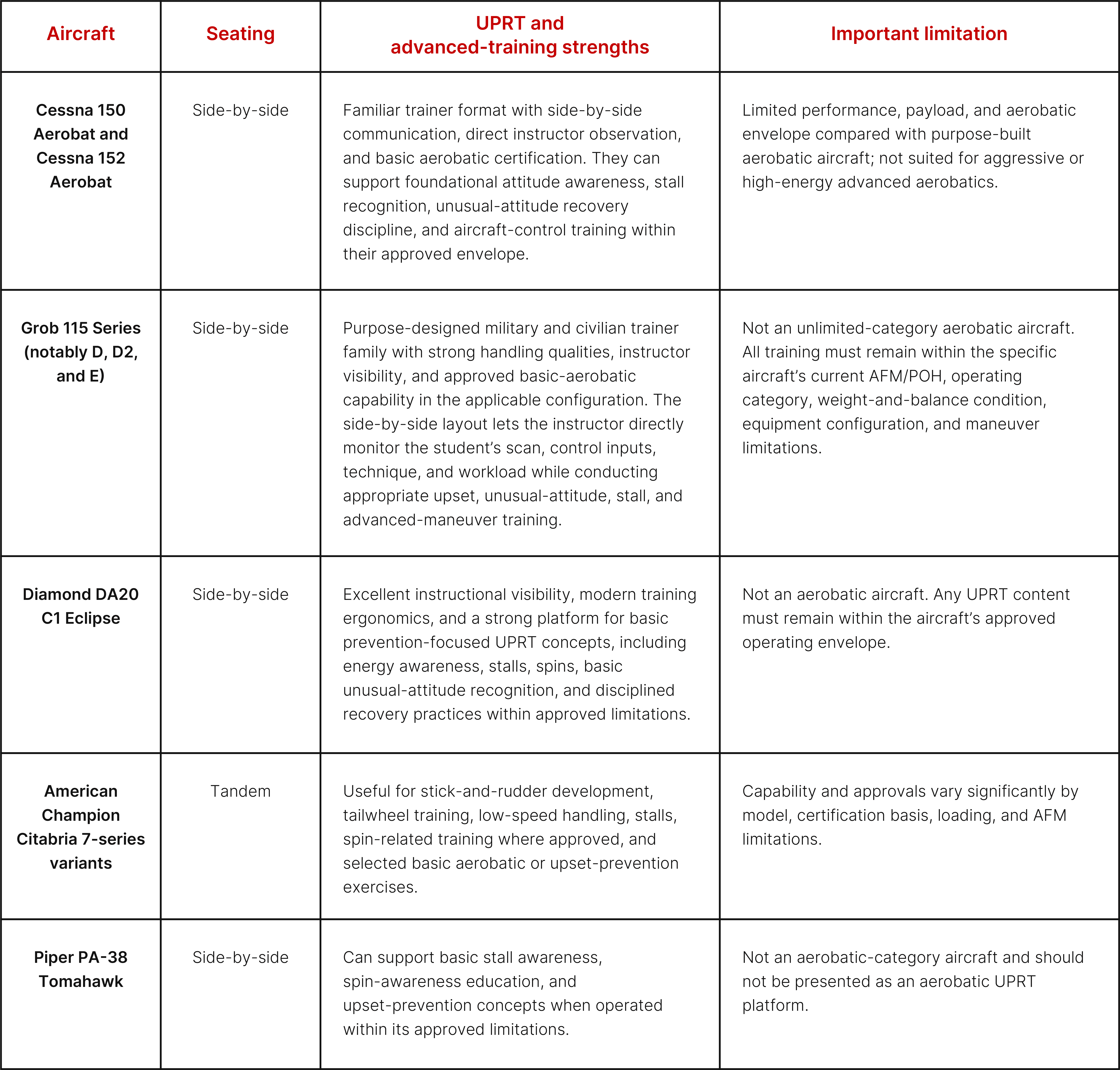
The Grob 115D2 and 115E deserve special attention in this comparison. It occupies useful middle ground between conventional primary trainers and highly specialized tandem aerobatic aircraft. Its training-oriented design and side-by-side seating provide the instructor with strong visibility of student technique, while its approved basic-aerobatic capability can support a more robust maneuvering curriculum than is available in many ordinary trainers.
That does not mean a Grob should be treated as an unlimited aerobatic airplane. It means the aircraft can be an especially effective platform for a training organization that wants to teach prevention, recognition, disciplined recovery, and sound aircraft control while preserving the practical instructional advantages of adjacent seating. The controlling source for every maneuver remains the individual aircraft’s current approved flight manual and limitations—not a generic description of the model family.
Tandem Aircraft: Excellent, but Specialized
Tandem aircraft such as the Extra 300, Super Decathlon, Pitts, and similar aerobatic airplanes can offer capability that many side-by-side trainers do not: higher roll rates, larger maneuvering envelopes, sustained inverted flight, more simple energy management, and exposure to more aggressive all-attitude maneuvering.
Those capabilities make a purpose-built tandem aircraft a valuable tool for advanced aerobatics, and certain UPRT courses. The Extra 300L, for example, is an unlimited-category aerobatic aircraft used in certain upset-training programs because of its easier controllability and higher maneuverability, which many treat as the most important aspect of upset recovery.
However, aircraft capability is not the same as instructional suitability. A tandem aerobatic airplane may be ideal for an advanced maneuvering flight while still being less effective than a side-by-side trainer for a student learning to improve recognition, prevention, recovery, and judgment in a controlled environment—and then ensure those skills transfer to the pilot’s normal operating environment.
The Tandem Communication Issue
The tandem layout creates a specific operational concern during aerobatic and UPRT flights: an intercom failure can rapidly turn into a high-stress cockpit-management event.
In a side-by-side airplane, an intercom failure is still a serious distraction, but instructor and student can usually see one another’s face, hands, gestures, body language, and control movements. They can point, establish eye contact, use written cues, or apply prebriefed visual signals. The instructor can also better judge whether the student remains in control, has become confused, or needs assistance.
In a tandem aircraft, the occupants may not be able to see each other at all. They can have different views of the horizon, panel, outside references, traffic, and aircraft attitude. If communication is lost in the middle of a high-workload maneuver and the crew has not explicitly planned for it, both pilots may believe they need to assume the flying role.
That creates the real danger: ambiguous authority, where both occupants attempt to take the pilot-in-command or control role at the same time.
This is not an argument against tandem training. It is an argument for treating cockpit communication and control transfer as critical elements of the training plan—not assumptions. The standard should be simple: if communications fail, neither pilot should have to guess who is flying the airplane.
Bottom Line
Side-by-side seating is the default for most flight training because it improves communication, instructor observation, shared visual references, student confidence, and early intervention.
The same applies with civilian UPRT. A capable side-by-side aircraft - like a Grob 115D2 operated within its approved limitations can combine a true trainer’s instructional advantages with basic-aerobatic capability. That allows an instructor to teach upset prevention, threat recognition, aircraft control, and recovery discipline without sacrificing the ability to closely monitor the student.
Tandem aerobatic aircraft remain valuable tools. They are often the correct choice for aggressive aerobatics or military jet transition upset exposure training. But the tandem layout demands deliberate communication procedures, explicit transfer-of-control discipline, and an unambiguous plan for an intercom failure.
For most students and training missions, the strongest learning environment remains a side-by-side cockpit: one where instructor and student can see each other, understand the same situation, and maintain a clear shared understanding of who is flying the airplane.