Pilot Training in the DFW Area: Finding the Right Flight School
Grid

Flight School Cost Comparison 2026: Real Prices & Hidden Fees

If you are researching flight school costs in 2026, you have likely seen a wide range of advertised prices. Some schools promise a Private Pilot License for as little as $10,000, while others quote $70,000 to $110,000 to go from zero experience to airline-ready. The difference is rarely about quality alone. It often comes down to what is and is not included in the price. Understanding the real cost of flight training and how different pricing models compare can help you make a more informed decision.
Grid

The Real Cost of Flight Training in 2026

According to a 2025 analysis of over 150 flight schools across all 50 states, the true average cost of earning a Private Pilot License (PPL) in 2026 is $15,400. That figure is roughly 40% higher than many schools advertise as a “starting at” price. Individual estimates range from $10,000 to $20,000 for a PPL, depending on location, aircraft rental rates, instructor fees, and how quickly a student progresses. Pilot lessons themselves cost $150 to $250 per hour for single-engine aircraft in 2026.

Beyond the PPL, the total investment to become a commercial pilot jumps significantly. Flight training in the United States usually costs $70,000 to $110,000 from zero experience to being ready for an airline job. More realistic estimates for a “job-ready” pilot in 2025 or 2026 fall between $95,000 and $130,000. This range accounts for the fact that many students need extra hours or additional training beyond the regulatory minimums.

The Real Cost of Flight Training in 2026

According to a 2025 analysis of over 150 flight schools across all 50 states, the true average cost of earning a Private Pilot License (PPL) in 2026 is $15,400. That figure is roughly 40% higher than many schools advertise as a “starting at” price. Individual estimates range from $10,000 to $20,000 for a PPL, depending on location, aircraft rental rates, instructor fees, and how quickly a student progresses. Pilot lessons themselves cost $150 to $250 per hour for single-engine aircraft in 2026.

Beyond the PPL, the total investment to become a commercial pilot jumps significantly. Flight training in the United States usually costs $70,000 to $110,000 from zero experience to being ready for an airline job. More realistic estimates for a “job-ready” pilot in 2025 or 2026 fall between $95,000 and $130,000. This range accounts for the fact that many students need extra hours or additional training beyond the regulatory minimums.

From Private Pilot to Airline Ready: Understanding the Full Path

Getting from a first flight lesson to the 1,500 hours required for an Airline Transport Pilot certificate involves multiple stages. Each stage carries its own costs, and how a school structures those stages can greatly affect your total bill.

• Private Pilot License (PPL): The foundation. Average cost $15,400. Typical range $10,000–$20,000.

• Instrument Rating (IR): Adds the ability to fly with instruments only. Expected cost $8,000–$12,000.

• Commercial Pilot License (CPL): Allows you to be paid to fly. Cost $10,000–$15,000 as an add-on.

• Certified Flight Instructor (CFI, CFII, MEI): Many pilots build hours by teaching. Costs $5,000–$10,000 for the certificates.

• Multi-Engine Rating: Required for most commercial jobs. Approximately $5,000–$8,000.

Adding these up, a pay-as-you-go student can expect a total in the range of $95,000 to $130,000, matching the realistic job-ready estimates. However, this sum does not always include expenses like ground school kits, headsets, flight bags, or housing.

From Private Pilot to Airline Ready: Understanding the Full Path

Getting from a first flight lesson to the 1,500 hours required for an Airline Transport Pilot certificate involves multiple stages. Each stage carries its own costs, and how a school structures those stages can greatly affect your total bill.

• Private Pilot License (PPL): The foundation. Average cost $15,400. Typical range $10,000–$20,000.

• Instrument Rating (IR): Adds the ability to fly with instruments only. Expected cost $8,000–$12,000.

• Commercial Pilot License (CPL): Allows you to be paid to fly. Cost $10,000–$15,000 as an add-on.

• Certified Flight Instructor (CFI, CFII, MEI): Many pilots build hours by teaching. Costs $5,000–$10,000 for the certificates.

• Multi-Engine Rating: Required for most commercial jobs. Approximately $5,000–$8,000.

Adding these up, a pay-as-you-go student can expect a total in the range of $95,000 to $130,000, matching the realistic job-ready estimates. However, this sum does not always include expenses like ground school kits, headsets, flight bags, or housing.

Cost Breakdown Comparison: Pay-as-You-Go vs. All-Inclusive

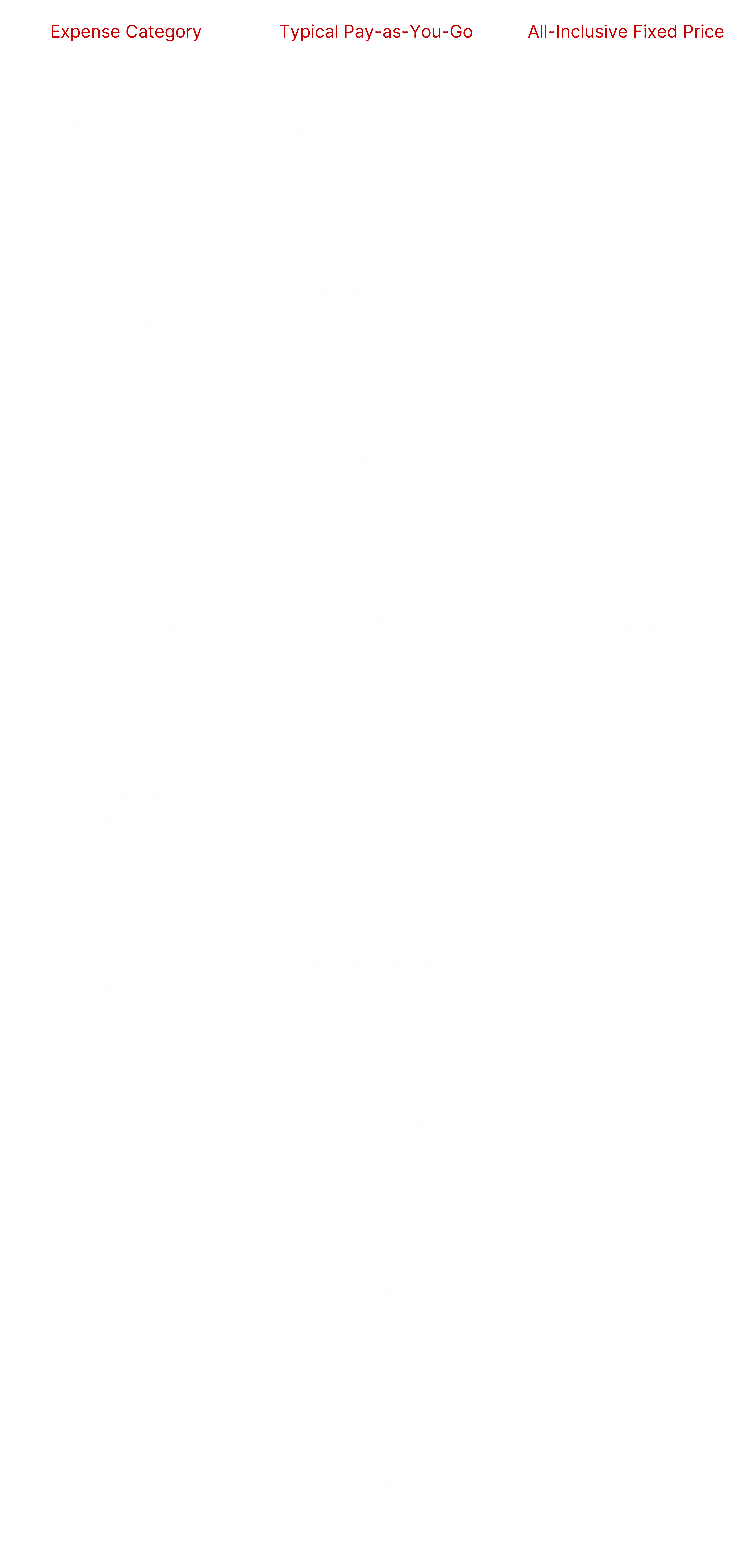
The table below compares typical cost categories found at traditional flight schools versus what an all-inclusive fixed-price program might cover. Keep in mind that exact figures vary by school and region.

Cost Breakdown Comparison: Pay-as-You-Go vs. All-Inclusive

The table below compares typical cost categories found at traditional flight schools versus what an all-inclusive fixed-price program might cover. Keep in mind that exact figures vary by school and region.

When a flight school charges separately for each item, the total can easily exceed the advertised “tuition.” For example, a school might quote $70,000 for a program, but then add thousands more in fees for checkrides, written tests, instructor time, and materials. An all-inclusive fixed price bundles these costs from the start, giving you one predictable number.

When a flight school charges separately for each item, the total can easily exceed the advertised “tuition.” For example, a school might quote $70,000 for a program, but then add thousands more in fees for checkrides, written tests, instructor time, and materials. An all-inclusive fixed price bundles these costs from the start, giving you one predictable number.

Hidden Costs That Drive Up Your Total

One of the biggest frustrations for students is discovering additional expenses after enrollment. Ground school is sometimes priced separately, or schools charge for each FAA written exam and checkride individually. Instructor fees can be billed per hour in addition to the aircraft rental, meaning a $180 per hour aircraft might actually cost $270 per hour once the instructor’s time is added.

Beyond training itself, living expenses matter. A four-year aviation degree program can cost $80,000 to $200,000 in tuition, room, board, and fees, without even including all flight training costs. For students who relocate to attend a flight school, housing and transportation to the airport add thousands of dollars that are rarely part of the quoted price.

Another hidden factor is the number of flight hours needed. The FAA requires 40 hours for a PPL, but the national average is around 65 to 75 hours. Students who train at schools that charge by the hour must cover the full cost of those extra hours. Fixed-price programs often include enough hours to reach proficiency, reducing the risk of unexpected bills.

Hidden Costs That Drive Up Your Total

One of the biggest frustrations for students is discovering additional expenses after enrollment. Ground school is sometimes priced separately, or schools charge for each FAA written exam and checkride individually. Instructor fees can be billed per hour in addition to the aircraft rental, meaning a $180 per hour aircraft might actually cost $270 per hour once the instructor’s time is added.

Beyond training itself, living expenses matter. A four-year aviation degree program can cost $80,000 to $200,000 in tuition, room, board, and fees, without even including all flight training costs. For students who relocate to attend a flight school, housing and transportation to the airport add thousands of dollars that are rarely part of the quoted price.

Another hidden factor is the number of flight hours needed. The FAA requires 40 hours for a PPL, but the national average is around 65 to 75 hours. Students who train at schools that charge by the hour must cover the full cost of those extra hours. Fixed-price programs often include enough hours to reach proficiency, reducing the risk of unexpected bills.

Fixed-Price Programs vs. Pay-as-You-Go

Pay-as-you-go models give flexibility, you pay only for what you use each session. However, this approach makes it difficult to budget for the entire training journey. A student who progresses slower than average, or who needs extra preparation for checkrides, can end up spending far more than the school’s initial estimate.

All-inclusive fixed-price programs offer the opposite advantage: transparency. You know the total cost upfront, and the school typically absorbs the risk of extra hours, retakes, and price increases during your training. Programs that include housing, transportation, a professional pilot kit (iPad, headset, flight bag, ForeFlight subscription), and all exam fees remove the hassle of coordinating separate purchases.

Which model is smarter depends on your situation. If you have the discipline to stick to a minimum-hour curriculum and can manage variable costs, pay-as-you-go might work. But if you want predictability and are willing to pay a single price for everything needed to reach 1,500 hours, a fixed-price program provides peace of mind.

Fixed-Price Programs vs. Pay-as-You-Go

Pay-as-you-go models give flexibility, you pay only for what you use each session. However, this approach makes it difficult to budget for the entire training journey. A student who progresses slower than average, or who needs extra preparation for checkrides, can end up spending far more than the school’s initial estimate.

All-inclusive fixed-price programs offer the opposite advantage: transparency. You know the total cost upfront, and the school typically absorbs the risk of extra hours, retakes, and price increases during your training. Programs that include housing, transportation, a professional pilot kit (iPad, headset, flight bag, ForeFlight subscription), and all exam fees remove the hassle of coordinating separate purchases.

Which model is smarter depends on your situation. If you have the discipline to stick to a minimum-hour curriculum and can manage variable costs, pay-as-you-go might work. But if you want predictability and are willing to pay a single price for everything needed to reach 1,500 hours, a fixed-price program provides peace of mind.

How to Compare Flight School Costs in 2026

When evaluating schools, ask for a detailed written breakdown that includes every expected fee. Look beyond the headline number. Key questions to ask:

• Does the quoted price include all flight hours needed to meet proficiency, not just the FAA minimums?

• Are instructor fees billed separately from aircraft rental?

• Are FAA written exam fees and checkride fees covered?

• What is included in the pilot kit, headset, iPad, software, bag?

• Is housing provided or is there a housing allowance?

• Is airport transportation included?

• Does the program offer career preparation, such as resume building and airline interview prep?

Schools that provide a structured path to 1,500 hours, including multi-engine time and instructor certificates, can help you complete your training faster. Financing options are also worth investigating. Many students rely on loans or payment plans, so confirm whether the school partners with lenders that cover the full fixed price.

How to Compare Flight School Costs in 2026

When evaluating schools, ask for a detailed written breakdown that includes every expected fee. Look beyond the headline number. Key questions to ask:

• Does the quoted price include all flight hours needed to meet proficiency, not just the FAA minimums?

• Are instructor fees billed separately from aircraft rental?

• Are FAA written exam fees and checkride fees covered?

• What is included in the pilot kit, headset, iPad, software, bag?

• Is housing provided or is there a housing allowance?

• Is airport transportation included?

• Does the program offer career preparation, such as resume building and airline interview prep?

Schools that provide a structured path to 1,500 hours, including multi-engine time and instructor certificates, can help you complete your training faster. Financing options are also worth investigating. Many students rely on loans or payment plans, so confirm whether the school partners with lenders that cover the full fixed price.

Frequently Asked Questions

How much does a Private Pilot License cost in 2026?

The average cost is $15,400, though individual schools quote from $10,000 to $20,000. Advertised “starting at” prices often exclude instructor fees, exam fees, and extra flight hours, so always ask for a total estimate.

Is it cheaper to train abroad than in the United States?

Some countries offer lower hourly rates for aircraft and instruction. However, you must also consider travel, accommodation, and the process of converting a foreign license to an FAA certificate. The total cost of an international program can range from $85,000 to $150,000 USD.

How long does it take to become an airline pilot?

Full-time training from zero experience to 1,500 hours typically takes 12 to 24 months, depending on weather, aircraft availability, and the school’s structure. Programs that include instructor training and multi-engine time can keep you on a consistent schedule.

What is included in an all-inclusive flight school program?

Generally, an all-inclusive program bundles single and multi-engine flight hours, instructor fees, ground school, all FAA written and checkride fees, a pilot kit with headset and iPad, uniforms, and housing with airport transportation. Some also provide career coaching and airline interview preparation.

Can I finance flight training?

Yes. Many flight schools offer financing options or partner with lenders that specialize in aviation training. Fixed-price programs may be easier to finance because the total cost is known upfront, allowing for a single loan amount that covers the entire curriculum.

Are you curious about Flight College? Whether you’re just starting your research or ready to enroll, our team is here to assist you.


Call or text us at (844) 321-5679

A Najaf logo

© Flight College 2026

Are you curious about Flight College? Whether you’re just starting your research or ready to enroll, our team is here to assist you.


Call or text us at (844) 321-5679

A Najaf logo

© Flight College 2026

Are you curious about Flight College? Whether you’re just starting your research or ready to enroll, our team is here to assist you.


Call or text us at (844) 321-5679

A Najaf logo

© Flight College 2026